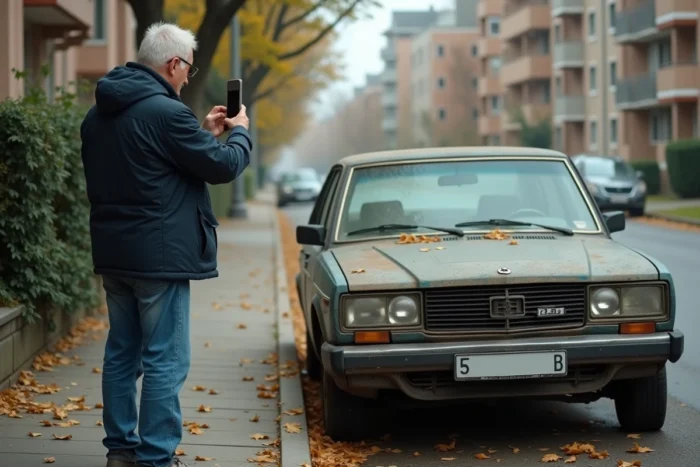
A gray sedan parked in the same spot for weeks, flat tires, a layer of dust on the windshield: we all know that vehicle that occupies a space without ever moving. Before wasting time on unnecessary procedures, it’s better to understand what the law actually considers a “ventouse” car and to direct your report to the right contact.
Ventouse car, wreck or abusive parking: distinguish the cases before reporting
Three situations that do not fall under the same treatment are often confused. A vehicle in abusive parking exceeds the authorized duration (generally seven consecutive days on public roads) but remains in a drivable condition. A ventouse car is one that has been immobilized well beyond this time frame, sometimes for months, without the owner coming forward.
A wreck goes further: a vehicle that is out of service, lacking plates or visibly damaged, sometimes a source of unsanitary conditions. The administrative treatment differs according to the category, and a misclassification slows down the process. If the vehicle still has its plates and seems drivable, it is considered abusive parking or a ventouse car. If it is missing elements or poses a danger, it is a wreck, and the town hall can initiate a specific removal procedure.
Before any reporting, it’s beneficial to know how to report a ventouse car according to the correct category, which directly guides you to the competent service.

Reporting via municipal application or online portal: the fastest option
The classic reflex remains to call the municipal police or go to the police station. It works, but more and more municipalities are now offering digital citizen reporting platforms, either through a web portal (like a “citizen space”) or through a dedicated app like Signaleo.
These tools systematically require precise geolocation, photos, and the license plate number. In return, you receive a case number that allows you to track the progress. This is a concrete advantage compared to a simple phone call, where the written record depends on the goodwill of the officer.
What to prepare before filling out the form
- The exact location of the vehicle: street number, visual landmark, GPS coordinates if the app allows it
- Several dated photos showing the condition of the vehicle, its position, and, if possible, a readable license plate
- An estimate of the duration of immobilization (how long the vehicle has not moved, based on your observations)
- The type of roadway: public municipal road, private residential parking, or co-ownership, as the contact person changes
On a public road, it is the municipal or national police that intervenes. In co-ownership or private residence, it is the property manager who must initiate the procedure, not directly the law enforcement agencies. This point creates a lot of confusion.
Ventouse car in co-ownership: why the procedure often stalls
In co-ownership, parking areas are common or private parts according to the regulations. In both cases, the municipal police cannot spontaneously intervene on private property. It must go through the property manager, who must first attempt to identify the owner of the vehicle.
If the owner is a co-owner or tenant of the residence, the property manager sends a formal notice by registered mail. Without a response within a reasonable time, the property manager can request the vehicle’s towing from the prefecture, but only if the vehicle is clearly abandoned or constitutes an abnormal disturbance.
If the owner is unknown, the situation becomes complicated. The property manager must then contact the vehicle registration service to attempt identification via the plate, then initiate the procedures with the mayor of the municipality. Responses vary on this point: some property managers obtain removal in a few weeks, while others wait several months.
Blocking firefighter access or emergency lane
One case significantly accelerates the procedure: when the ventouse car blocks firefighter access or an emergency lane. Municipalities prioritize these reports, as the security risk justifies a quick intervention. Mentioning this element in the report (with a photo of the obstructed area) changes the priority level of the case.
Legal deadline for towing and tracking the report
On public roads, once the report is made and the observation is carried out by an officer, a legal deadline applies before towing. The officer places a notice on the vehicle, and the owner has a certain number of days to move it. If the vehicle is still there at the end of this period, towing may be ordered.
In practice, the availability of towing services is the main bottleneck. The garages authorized by the prefecture are often overwhelmed. In Villiers-le-Bel, the municipal police remove nearly 700 vehicles a year, but the town hall acknowledges that the time between reporting and towing directly depends on the available spaces in the towing service.
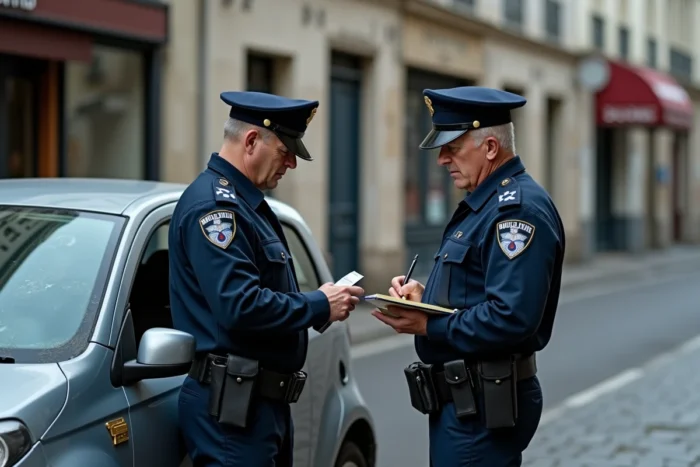
Another peculiarity: some municipalities suspend towing during the summer period to avoid penalizing residents on vacation whose vehicles are legitimately parked longer than usual.
Effectively following up after a first report
If nothing happens after two to three weeks, a written follow-up (email or letter) to the town hall or municipal police with the case number and new dated photos concretely reactivates the processing. A report without follow-up is unlikely to be resolved quickly.
On digital platforms, some municipalities display a processing status visible to the reporter. When this feature exists, it avoids unnecessary follow-ups and provides real visibility on progress.
The key point to remember: the speed of removal depends less on the quality of the initial report than on the saturation of towing services and the responsiveness of the property manager (in co-ownership) or the municipal police (on public roads). Documenting the vehicle accurately and following up in writing remains the most reliable method to advance a ventouse car case in your neighborhood.