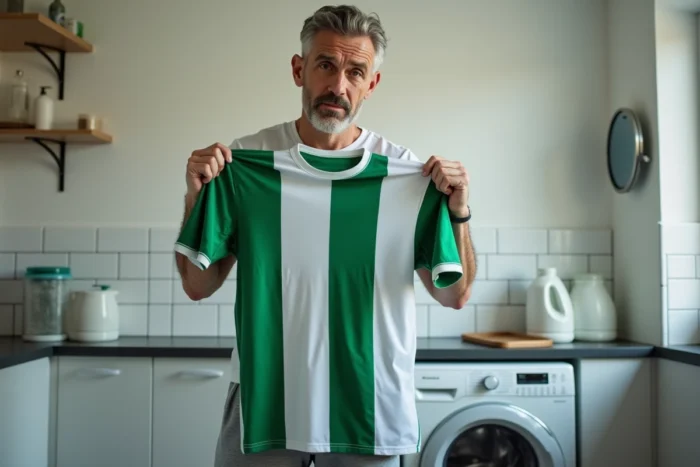
A football jersey that is too large floats on the shoulders, gapes at the belly, and ruins the silhouette. Before attempting anything, it is essential to understand a technical point: recent polyester jerseys are highly resistant to shrinking. Manufacturers calibrate their fabrics to limit deformation, precisely so that the size and markings remain stable throughout the season.
A hot wash will therefore not produce the same effect as on an old cotton t-shirt.
Technical polyester and shrinking: why your jersey resists
Polyester fiber is thermoplastic. It deforms under the influence of heat, but football jersey manufacturers exploit this property in reverse: they stabilize the fabric in the factory so that it hardly moves afterward. Residual shrinking is intentionally capped, often at a few percent in length and width.
In practical terms, a cycle at 60 °C on a recent 100% polyester jersey will yield a disappointing result. You might gain half a size, rarely more. This is why the “boiling water + dryer” techniques work mainly on old jerseys, low-end replicas, or models containing a portion of cotton.
You may have noticed that some vintage jerseys shrink after the first wash while current versions remain unchanged? The composition of the fabric explains everything. Before choosing a method, turn the jersey inside out and read the composition label. This is the only reliable starting point.
Several tips for adjusting a jersey circulate online, but their effectiveness directly depends on this basic data.
Shrinking a football jersey in the wash: method and limits
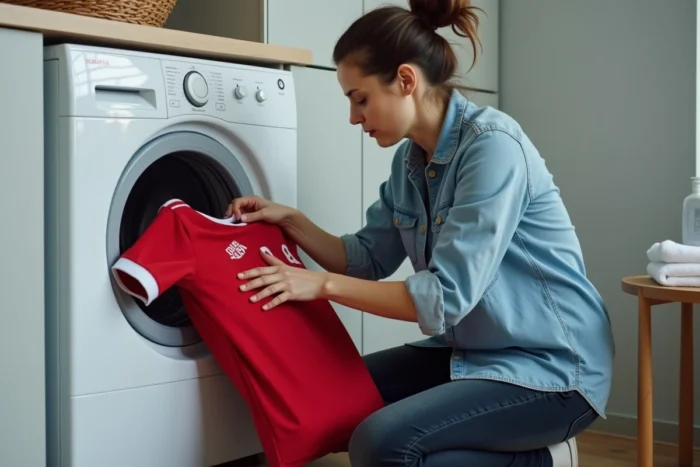
Washing at high temperature remains the most attempted method. It works, under certain conditions.
Jersey with a portion of cotton
If the label indicates a cotton-polyester blend, the potential for shrinking increases. Cotton reacts to hot water by contracting at the fiber level. A cycle at 60 °C followed by a tumble dry on high heat can make the jersey lose a size.
100% polyester jersey
A 100% polyester jersey will shrink very little in the wash, even at high temperatures. You can try a cycle at 60 °C, but do not expect a visible change. The high-temperature dryer provides a slight boost, but no miracles.
In both cases, turn the jersey inside out before putting it in the machine. The friction of the drum on the printed side accelerates the wear of the prints.
Prints and logos: the real risk when heating a jersey
This is the angle that most tutorials overlook. Vinyl or PU prints degrade beyond 40 °C. The numbers, player names, and sponsor logos are glued or heat-sealed onto the fabric. Direct heat, the pressure of the drum, and intensive drying weaken these elements well before the fabric itself shrinks.
Here’s what happens concretely when you push the temperature:
- The vinyl of the print begins to peel at the edges, especially at the corners of letters and numbers
- The colors of the sponsor logo may fade or crack after two or three hot cycles
- The fabric around the print sometimes deforms differently from the rest of the jersey, creating a wavy effect
If your jersey has a print that you care about, heat is a solution to avoid. It is better to go directly to sewing alterations.
Sewing alterations: the only reliable method to adjust a polyester jersey
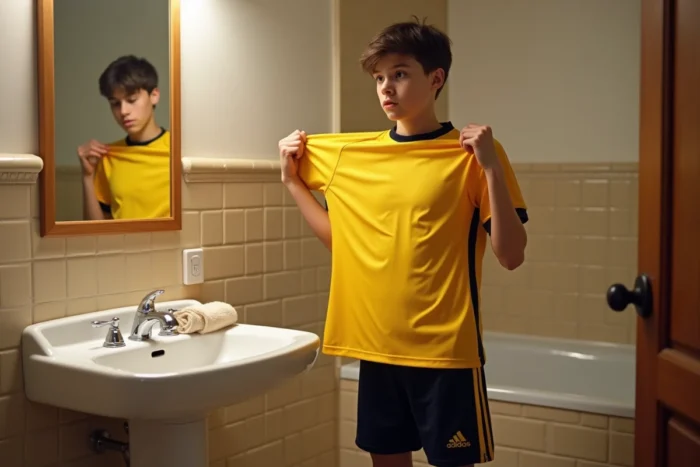
Taking in a football jersey at the side seams is the technique that offers the best control. A tailor can taper the bust, shorten the sleeves, and adjust the length without touching the prints.
Polyester sews easily with a synthetic fabric needle (ballpoint) and polyester thread. The seams of a football jersey are generally simple topstitching, reproducible on a home machine.
Before sewing, turn the jersey inside out and pin the excess fabric along the side seams. Always pin the jersey while wearing it, never flat, to follow the actual curve of the bust. Then carefully remove the jersey and sew along the pins.
To shorten a jersey that is too long, fold the bottom inward and make a simple hem. If the jersey has an elasticated bottom (ribbed band), you will need to unpick it, cut the fabric, and then sew it back on. This type of alteration takes a few minutes on a standard sewing machine.
Temporary tips without sewing or washing
Do you not have a sewing machine and the match is in two hours? There are a few quick solutions.
- The side knot: gather the excess fabric on one side, at the hip, and tie it with a small hair elastic. This technique is very popular on TikTok and works well for a casual look
- The partial tuck-in: tuck the front of the jersey into the shorts while leaving the back loose. This structures the silhouette without altering the garment
- Safety pins placed inside, along the side seams, to pinch the fabric invisibly. A fragile but effective solution for an evening
These solutions do not replace a proper alteration, but they help when time is short.
Shrinking a football jersey primarily depends on its fabric composition. On a recent technical polyester model, heat alone will almost never be enough. Sewing alterations remain the most precise method, and the only one that preserves the prints. If the jersey has no specific markings and contains cotton, a hot cycle followed by the dryer may be worth a try, accepting the risk of a modest result.