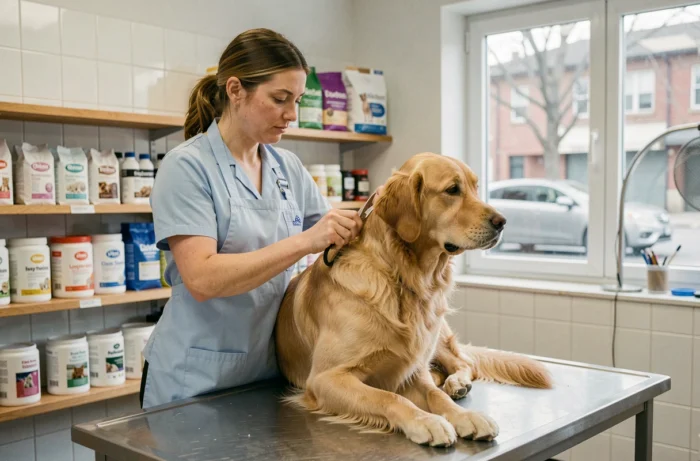
Does your rough-coated dog look like a tired mop despite regular brushing? The problem likely comes from dead hair that remains attached to the follicle without ever falling out. Animal hair removal, also known as stripping, involves manually removing these dead hairs to allow new growth. This grooming technique applies to specific breeds, relies on specific techniques, and requires real precautions to respect the animal’s well-being.
Rough coat and undercoat: understanding the mechanics before stripping your dog
Before discussing techniques, it’s important to understand why some dogs need to be stripped and others do not. It all comes down to the structure of the coat.
Rough-coated breeds (terriers, schnauzers, certain spaniels, and hunting dogs) have two distinct layers. The topcoat, coarse and stiff, protects against rain and friction. The undercoat, dense and soft, provides thermal insulation.
In these breeds, the dead hair remains attached to the follicle instead of falling out. It accumulates, suffocates the skin, and prevents new hair from emerging. The coat becomes dull, fluffy, and loses its waterproof properties. This is where stripping comes in: it frees the follicle so that new hair can grow with its original hard texture and color.
A dog with silky or smooth hair does not have this problem. Its hair falls out naturally. Taking it to a groomer for stripping makes no sense, and a serious professional like Transpoil will guide you towards care suited to the true nature of the coat.
Stripping, trimming, and clipping: what each technique does to the coat
These three terms often come up in grooming salons. They do not refer to the same thing, and confusing them can permanently damage your dog’s coat.
Stripping removes dead hair from the root
Stripping involves pinching the dead hair between the thumb and a stripping knife (a non-cutting blade) and then pulling in the direction of growth. When the hair is in the telogen phase (dead), it detaches easily. A mature hair is pulled out without pain for the animal.
The result: a freed follicle, colored regrowth, and preserved hard texture. This is the reference technique for terrier breeds, schnauzers, or rough-coated greyhounds.
Trimming refines the finishes
Trimming complements stripping. It involves more delicate work, often done with fingers or a stone, to even out the coat and sculpt sensitive areas (around the ears, belly, legs). Some groomers also use a flat trimmer to remove excess undercoat before proceeding to the actual stripping.
Clipping cuts without extracting
The clipper cuts the hair in the middle without removing the dead root. The follicle remains blocked. Over time, the hair grows back softer, losing its pigmentation and waterproofing. For a show dog, this is unacceptable. For a pet dog, clipping is occasionally acceptable, but it does not replace stripping in the long term.
Signs of stress in dogs during grooming
Have you ever noticed that a dog remains perfectly still on the grooming table? Many owners interpret this stillness as calm. Recent behavioral observations show the opposite.
A frozen dog may show more pronounced physiological signs of stress than a dog that is fidgeting. A decrease in heart rate variability and suppression behaviors (averted gaze, nose licking, repeated yawning) signal real discomfort, even without visible movement.
This finding changes how to approach a stripping session:
- Prefer short sessions with regular breaks rather than a long uninterrupted session
- Minimize restraint to allow the dog to express its signals
- Observe micro-signals (flattened ears, low tail, head turning) that indicate the animal is reaching its limit
A competent groomer adapts their pace to the animal. If your dog shows signs of distress, it’s better to stop and resume later.

Stripping for older dogs or those with sensitive skin: when clipping becomes preferable
Stripping is not always the best option, even for a rough-coated breed. The comfort of the animal must take precedence over the desired texture of the coat.
An older dog whose skin has thinned struggles with the repeated micro-pulls of stripping. An animal suffering from eczema, skin allergies, or an inflammatory flare-up may see its lesions worsened by the action. In these cases, temporary clipping protects the skin while maintaining a manageable hair length.
Similarly, a dog that has never been stripped and reaches adulthood with a coat saturated with dead hair may require several progressive sessions. Attempting a complete stripping all at once on unaccustomed skin can cause redness, irritation, and sometimes small skin traumas, especially in thin-skinned areas like the belly or inner thighs.
- For an older or painful dog: prefer gentle clipping and consult your veterinarian before any session
- For a dog with reactive skin: test on a small area and wait a few days before continuing
- For a late first stripping: space out several appointments over a few weeks
Frequency and maintenance between stripping sessions
The frequency of stripping depends on the breed, rate of growth, and lifestyle of the dog. Generally speaking, one stripping session every three to four months is sufficient for most rough-coated breeds. Show dogs follow a tighter schedule, often called “rolling coat,” where the groomer strips by areas at different stages of maturity to maintain a consistently even coat.
Between sessions, regular brushing with a brush suitable for rough hair (such as a bristle brush or soft carding brush) removes dead undercoat and limits tangles. Weekly brushing extends the benefits of stripping and reduces the groomer’s workload during the next appointment.
A well-maintained coat between sessions retains its shine, protective texture, and waterproofing much longer than a coat left unattended for months.