
Buying a house in the Faroe Islands as a foreigner is not the same as acquiring property in Denmark or Norway. The archipelago has its own rules regarding real estate ownership, and these rules have tightened in recent years. Before dreaming of a grass-roofed home facing the North Atlantic, it is better to understand what the Faroese authorities concretely expect from a non-resident buyer.
Political Status of the Faroe Islands and Its Impact on Real Estate
The Faroe Islands are an autonomous territory linked to Denmark, but they are not part of the European Union. This point changes everything for a foreign buyer.
A European citizen does not have any automatic right to purchase property in the archipelago. The free movement facilities that the EU grants to its citizens do not apply here. Specifically, a French citizen is treated like any other non-Nordic foreigner in relation to the Faroese administration.
Citizens from Nordic countries (mainland Denmark, Sweden, Norway, Iceland, Finland) have slightly easier access due to Nordic cooperation agreements. For all others, the process is the same: one must go through a local authorization procedure, and this authorization is not automatic. Understanding the purchase conditions for foreigners remains a prerequisite for any serious approach.
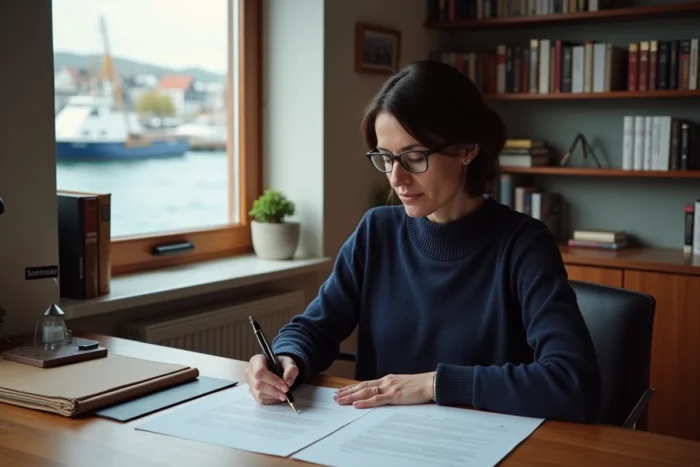
Purchase Authorization in the Faroe Islands: The Local Residency Criterion
Why are some applications rejected even when the buyer has the necessary funds? Because money is not enough. The determining criterion is the connection to the territory.
What the Authorities Require
The buyer must prove a lasting connection to the archipelago. The Faroese authorities evaluate each application individually. They check if the project corresponds to a real establishment, not to a financial investment or the acquisition of a vacation home.
Elements that strengthen a file:
- A signed employment contract with a Faroese employer, or the establishment of a local economic activity (fishing, aquaculture, tourism, services)
- A direct family connection, such as a Faroese spouse or children enrolled in schools on the archipelago
- A documented primary residence project, with a registered address and enrollment in the Faroese civil registry
What Is Rejected
Since 2022-2023, the authorities have been applying local residency rules more strictly. Applications for purely investment purchases or vacation homes are increasingly being rejected. The stated goal is clear: to preserve the housing stock for permanent residents and avoid price pressure in the villages.
A foreigner considering buying without settling permanently has very little chance of getting the green light. The Faroese policy aims to protect a limited real estate market in a territory of fewer than 55,000 inhabitants.
Faroese Real Estate Market: Prices and Ground Reality
Are you wondering what the market looks like? It is small, concentrated, and quite opaque for a foreigner.
Tórshavn, the capital, concentrates most of the supply and the highest prices. Rents in the city center for a one-bedroom apartment range from 8,000 to 10,000 DKK (Danish crown). Peripheral neighborhoods like Hoyvík or Argir offer rates that are 10 to 15% lower.
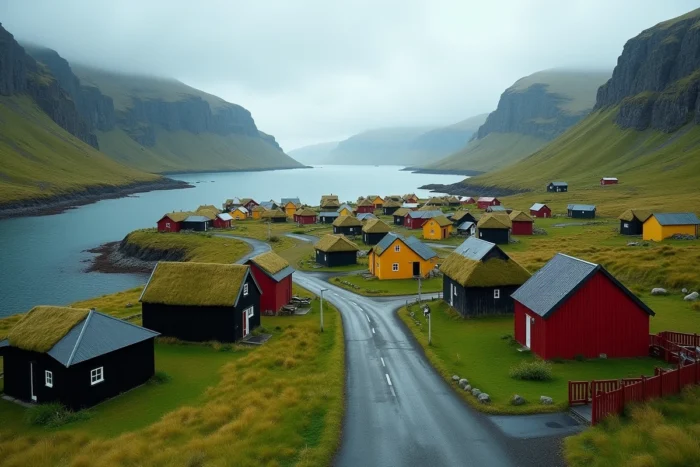
Outside Tórshavn, towns like Klaksvík (the second largest town in the archipelago) or Runavík offer a more rural setting and more accessible prices. The road network, including underwater tunnels, allows for easy connections between the inhabited islands.
There is no major international real estate portal that comprehensively covers the Faroe Islands. Listings mainly circulate through local networks, Faroese agents, and word of mouth. Finding a property without local contacts is almost impossible.
Visa, Residence Permit, and Financing: Practical Steps
Real estate purchase does not automatically grant a visa or residence permit. The reasoning works the other way around: it is the residence permit (obtained through employment, family reunification, or another legal basis) that opens the possibility to buy.
Obtaining a Residence Permit
For a non-Nordic citizen, the most common route is through a Faroese employment contract. The employer must demonstrate that no local or Nordic candidate could fill the position. Once the residence permit is obtained and actual residency on the archipelago is established, the application for real estate purchase authorization can be submitted.
Financing the Purchase
The Faroese banking system is distinct from the continental Danish system. Local banks can grant mortgages, but they generally require:
- Proof of stable income in the Faroe Islands
- A significant personal contribution (conditions vary by institution)
- Confirmed residency in the territory
Obtaining financing without residing on-site is the exception. International banks do not cover this market.
Fees and Taxation
The Faroese tax system is autonomous from Denmark. Tax rates, transfer duties, and property taxes follow a framework specific to the archipelago. Income is taxed according to a Faroese scale, and daily life (food, energy, transport) is significantly more expensive than in France or even in mainland Denmark.
Buying a house in the Faroe Islands remains a feasible project, provided it is approached as a life project and not as a remote investment. The archipelago selects its new owners based on their commitment to integrating into the local fabric. Without a Faroese job, family on-site, or an economic activity rooted in the archipelago, the door remains closed.