A repositioned sofa, a changed light fixture, a revisited wall color: sometimes, a single decorative gesture alters the entire perception of a room. The D Kom Déco universe follows this logic by offering new items that meet the current expectations of French interiors. Between soft colors inspired by nature, raw materials, and furniture designed for multifunctional spaces, this season’s trends deserve attention.
Biophilic design applied to interior decoration
Have you ever noticed that some rooms provide an immediate sense of calm? This result often stems from the presence of natural elements: a plant, a raw material, light that recalls the outdoors. In decoration, this principle has a name: biophilic design.
The idea goes beyond simply placing a planter on a windowsill. It involves integrating nature into the very structure of the space. An exposed stone wall, a light wood floor, linen curtains that filter daylight: each choice brings a sensory connection with the outside.
Professional sources in the industry confirm that this approach is now prevalent in both residential and commercial projects, with a focus on well-being and mental health rather than solely aesthetics. To find all the information on D Kom Déco, the seasonal selections illustrate this shift towards more organic atmospheres.
In practical terms, adopting biophilic design in an interior doesn’t require major renovations. Here are some effective ideas:
- Favor living materials like rattan, jute, or terracotta, which age well and add texture without overwhelming the space
- Maximize natural light by replacing opaque curtains with light drapes, or by positioning a mirror opposite a window
- Introduce evergreen plants in high-traffic areas (entryway, hallway) to create a continuous green thread throughout the home
Trendy decor colors: the plant palette and muted tones
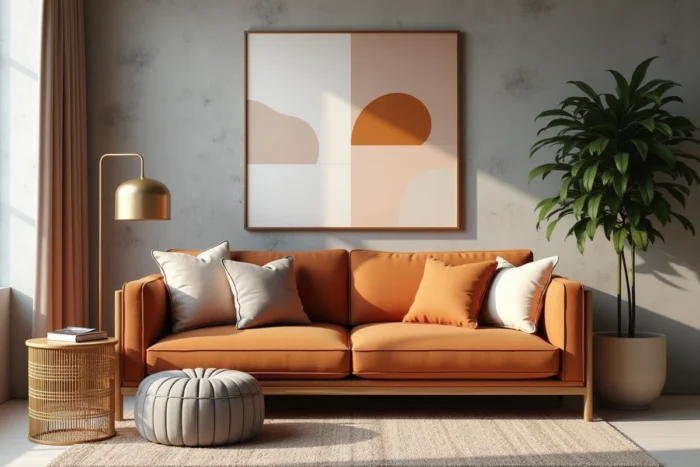
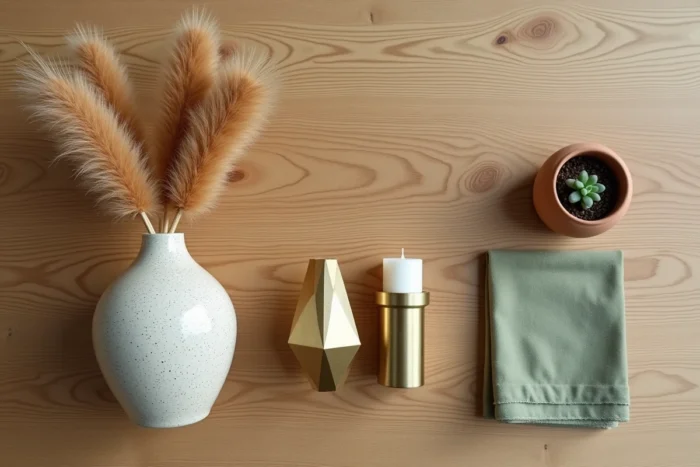
Saturated shades and contrasting combinations are giving way. The dominant palette of the season revolves around muted tones inspired by the plant world: sage green, softened terracotta, rosy beige, clay brown.
Why this choice? These colors function as a warm neutral backdrop. They absorb light instead of reflecting it harshly, which softens the overall atmosphere of a room. A living room painted in sage green feels more enveloping than a white living room, without visually shrinking the space.
The key takeaway: one strong shade per room is enough to create an identity. If you choose a terracotta wall in the dining room, the rest of the furniture and textiles should remain in neutral tones (ecru, sand, light gray). A common mistake is to multiply strong colors, which quickly creates visual fatigue.
Combining patterns and colors without overwhelming
Simple geometric patterns or wide stripes are making a comeback on cushions and throws. The principle remains the same: one strong pattern per visual ensemble. A solid sofa with patterned cushions works. A patterned sofa with different patterned cushions strains the eye.
Modular furniture for multifunctional spaces
The rise of remote work has profoundly changed how we use our rooms. A living room becomes an office during the day, a guest bedroom transforms into a gym. Modular furniture meets this space constraint in urban environments.
Market studies on interior design show a clear increase in demand for transformable furniture: extendable tables, repositionable shelves, benches with integrated storage. These are no longer compromise solutions: they are bold style choices.
A concrete example: a foldable wall console that serves as a desk during the day and disappears at night. Mounted on the wall, it takes up no floor space and frees up circulation in a small living room. Paired with a well-designed folding chair, it creates a functional workspace without sacrificing decor.
Criteria for choosing sustainable modular furniture
- Check the quality of hinges and folding systems, as these are the first elements to wear out on transformable furniture
- Prefer solid wood or metal over particle board, which does not withstand repeated handling well
- Test the furniture in both configurations before purchase to ensure that the transition is smooth and silent
Light floors and thin rugs: a change in floor texture
Thick, plush rugs are gradually leaving living rooms. The trend is moving towards light and breathable floors, which are easier to maintain and better suited for warm seasons.
Flat-woven rugs made of cotton or jute are replacing long-pile models. Their advantage: most can be machine washed, dry quickly, and do not trap dust. In a biophilic design-oriented interior, a natural fiber rug complements the coherence of materials.
This change in floor texture also alters the acoustics of a room. A hard floor without a rug reflects sound, which can make a space noisy. A thin natural fiber rug absorbs just enough resonance without creating the suffocating effect of a thick carpet.
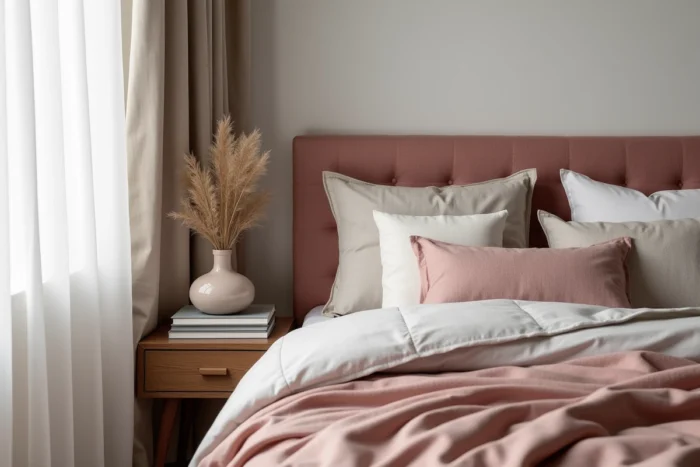
The new decor items brought by D Kom Déco converge towards a common direction: calmer interiors, sincere materials, furniture that adapts to real life. Style is built less by the accumulation of objects than by the precision of a few well-placed choices, piece by piece.