
When you need to cut oak baseboards at a 45° angle for a wall that isn’t quite straight, the tolerance is within half a degree. This is exactly the type of situation where a compact miter saw makes a difference. The Tacklife PMS03A fits this niche: clean angled cuts on modestly sized pieces of wood, without the budget or bulk of a professional machine.
Angle Adjustment and Real Precision on Site
On an entry-level miter saw, the critical point is not the motor’s power. It’s the reliability of the angle locking system. If the base plate turns freely but the stop notches don’t align perfectly at 15°, 22.5°, or 45°, you spend more time checking with a square than cutting.
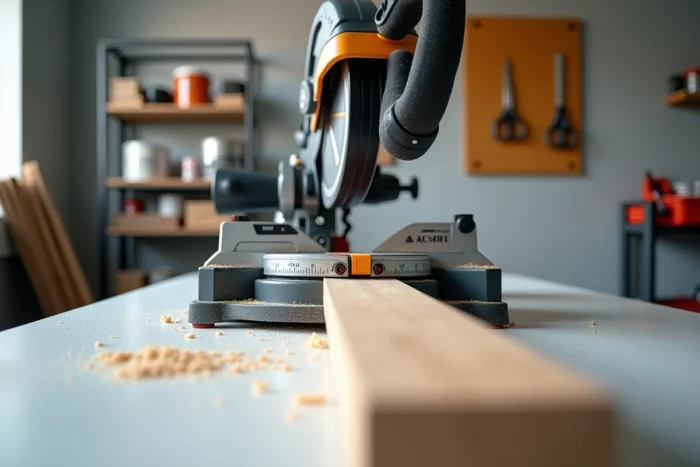
The Tacklife PMS03A offers preset stops for the most common angles. In practice, you set the head on the notch, check with a false square on the first two or three cuts, and then continue. For finishing work like installing moldings or frames, the repeatability of cuts matters more than raw power.
When working with the Tacklife PMS03A miter saw, you find that the table remains stable enough for softwood pieces of medium size. Feedback varies on the rigidity of the arm when cutting hard and thick wood, but that’s not the intended playground for this machine.
Cutting Capacity and Suitable Wood Types
Before buying a miter saw, the first question to ask is about the maximum size of the pieces you plan to cut. A modest diameter blade won’t cut through a structural beam, and no one should expect otherwise from a tool in this price range.
The PMS03A is designed for finishing work:
- Baseboards, quarter rounds, and decorative moldings in softwood or MDF, where the quality of the miter cut determines the final result
- Strips and small crosspieces for making frames, shelves, or lightweight structures
- Floating or laminate flooring, provided you fit a blade suitable for the material
- Thin aluminum profiles (provided you use an appropriate tooth blade and reduce the feed speed)
For solid wood beyond a certain thickness or very dense exotic wood, you quickly reach the limits of the motor. It’s better to reserve this machine for finishing cuts and leave heavy cuts to a more powerful radial saw.
Safety and Dust Extraction on a Compact Unit
A DIY workshop is rarely equipped with a centralized dust extraction system. Wood dust, especially from MDF, spreads everywhere and poses a real respiratory comfort issue during a multi-hour session.
The PMS03A includes a dust collection bag. On no miter saw in this category does the bag capture all particles. You collect the larger shavings, but a FFP2 mask is essential for extended sessions. Connecting a shop vacuum to the nozzle, when the diameter allows, significantly improves the situation.
On the mechanical safety side, the blade guard descends with the cutting arm. This is standard for this type of machine, but it should be checked before each use: a guard that sticks or doesn’t descend properly exposes fingers during the blade’s ascent.
Locking the Head in the Lower Position
When transporting the saw or storing it in a cluttered workshop, the arm must remain locked in the lower position to prevent it from rising and creating a risk. Checking the transport locking system is one of the reflexes to adopt right from unboxing.

Quality of the Supplied Blade and Replacement
The blade supplied with an entry-level miter saw is rarely one that you’ll keep for precision work. It allows you to validate the machine’s operation and make the first cuts, but the quality of the edge and the number of teeth often limit the finesse of the result.
For finishing carpentry, it’s worth investing in a blade with a higher tooth count. The finer the teeth, the cleaner the cut, and the less time you spend sanding edges. The blade diameter and bore must match the machine’s specifications exactly.
- For softwood and MDF, a fine alternate tooth blade provides clean edges without splintering
- For laminate, a specific blade with trapezoidal carbide teeth minimizes chipping of the decorative layer
- For thin aluminum, a negative tooth blade and suitable lubricant reduce the risk of jamming
Changing the original blade is the first useful investment after purchasing the machine. The ratio between the price of a good blade and the improvement in cut quality is overwhelmingly favorable.
Value for Money Against Established Brands
The PMS03A is often compared to models from brands like Bosch or Einhell, which occupy the same price segment or the segment just above. The price difference between these machines remains modest, but the technical trade-offs are not made in the same areas.
Established tool brands generally offer a denser network of spare parts and a more structured after-sales service. Tacklife compensates with an aggressive pricing strategy and comparable specifications on paper.
The choice depends on the expected volume of use: for occasional use, the PMS03A meets the specifications without straining the budget. For a tradesperson who uses their machine daily, long-term durability and parts availability weigh more heavily.
In a well-organized workspace, with a blade suitable for the material and settings checked with a square before each series, the Tacklife PMS03A delivers clean miter cuts for most finishing woodwork. It is a machine that finds its place in a DIY workshop that demands quality finishes, provided you don’t expect it to perform like a professional tool.