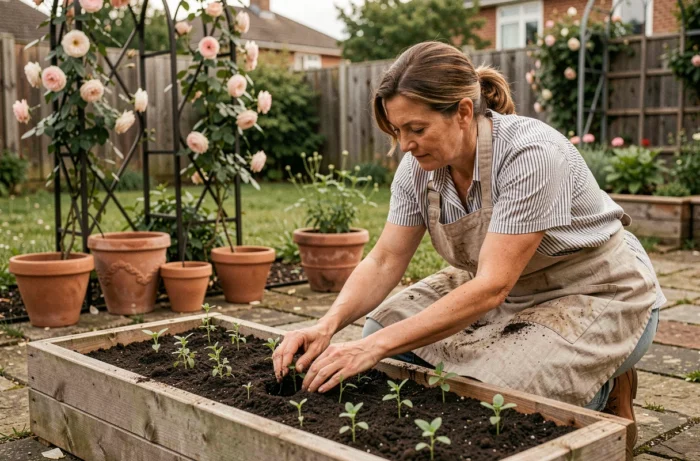
A well-functioning garden rarely starts with the choice of plants. It begins with the soil, the available light, and especially with a constraint that many homeowners discover too late: water. Creating a harmonious garden today means working with drier summers, local watering restrictions, and a soil that must be learned before planting.
Soil and water: the two parameters that decide everything in a garden
Have you ever noticed that some plants thrive effortlessly at a neighbor’s house while they wither at yours, just a few meters away? The difference often lies in the soil. Clay soil retains water but suffocates in winter. Sandy soil drains quickly, sometimes too much.
Before planting, take a handful of soil from about twenty centimeters deep. If it forms a compact ball when you squeeze it, it contains a lot of clay. If it crumbles immediately, it is more sandy. This simple test guides the choice of plants much better than a photo found online.
Working the soil before choosing plants avoids most failures. A thick mulch (dead leaves, branch chippings, straw) protects the soil from drying out, nourishes microorganisms, and limits watering. It is the foundation of a resilient garden, and it is also the approach favored by professionals listed on the Jardins & Paysages website for designing sustainable outdoor spaces.
On the water side, watering restrictions are no longer a one-time event. In times of drought crisis, watering lawns and ornamental gardens may be completely prohibited. Vegetable gardens sometimes benefit from allowed time slots, but not decorative flower beds. The VigiEau website allows you to check the measures in force at a specific address.
Owning a well does not necessarily change the situation. When the prefectural decree targets underground aquifers, a private well is subject to the same restrictions as network water. Only certain rainwater reserves disconnected from the natural environment may fall under a different regime.
Creating plant beds suited to the local climate
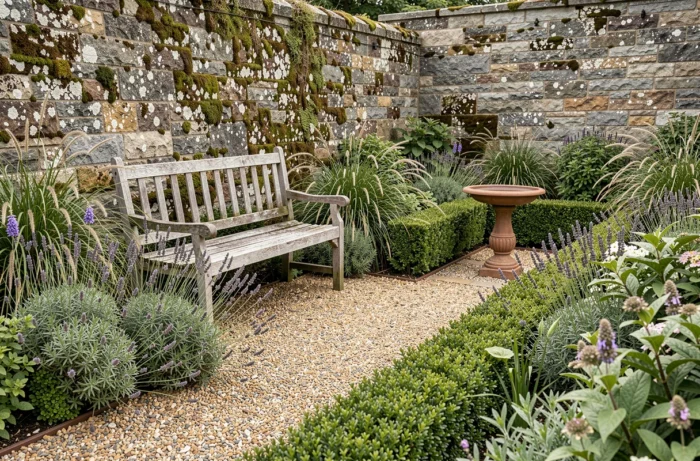
A harmonious bed relies on three levels of vegetation: a low layer that covers the ground, an intermediate layer that structures the view, and a few trees or large shrubs that provide verticality. This principle mimics how vegetation organizes spontaneously in nature.
Choosing self-sufficient plants
Instead of looking for the most spectacular flowers at the garden center, observe what is already growing in the wastelands and slopes around you. Native plants are adapted to the soil and climate without supplemental watering. They also attract local pollinators, making the garden more vibrant.
Here are some concrete criteria for selecting your plants:
- Hardiness: check that the plant can withstand the minimum temperatures of your region, not just the averages
- Water needs once established: favor species classified as “low water” or “drought-resistant” after the first year
- Ground cover: ground-covering plants (thyme, perennial geranium, yarrow) reduce evaporation and limit weeding
- Flowering period: by combining species that bloom in spring, summer, and fall, the garden remains colorful without seasonal replanting
Combining colors without discord
In a small space, stick to two or three dominant shades. Blue-purple combined with white creates a calming atmosphere. Yellow and orange energize a shady corner. Limiting the palette to three colors produces a more cohesive result than mixing all available shades.
In a larger garden, you can create successive “scenes” with different atmospheres. A warm bed (reds, oranges) near the terrace, a cool bed (blues, whites) at the back of the garden: this progression gives an impression of depth.
Designing living areas in the garden
An inviting garden is not just about planting. It is also a place to eat, where children play, and where one can relax. Each area deserves a different treatment in terms of soil and surroundings.
The terrace or dining area benefits from being close to the house to facilitate trips back and forth with the kitchen. Place the relaxation area where the sun falls in the late afternoon, as that is when it is most enjoyed. A simple shift of a few meters completely changes the comfort of use.
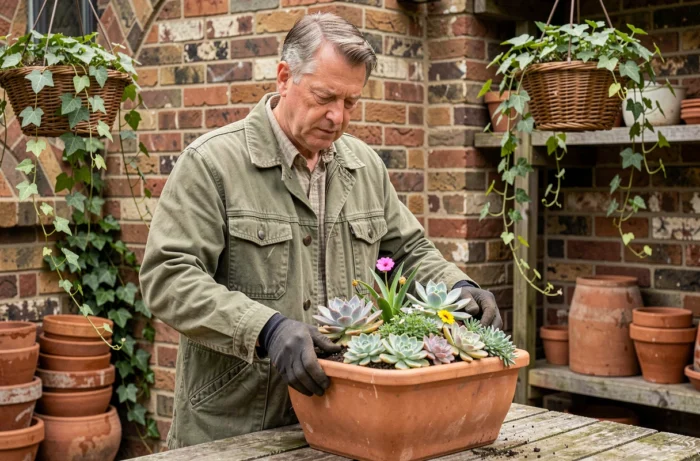
To delineate these spaces without partitioning, low hedges, tall grasses, or a change in ground covering (gravel, stepping stones, lawn) are sufficient. The idea is not to separate everything but to give each area a readable identity from the house.
The choice of furniture depends on the maintenance you are willing to provide. Untreated wood grays in one season but does not heat up in the sun. Metal lasts a long time but becomes scorching in summer. Woven resin offers a compromise, provided it is brought indoors in winter to prevent UV damage.
Minimal maintenance: choices that save time
Many gardens are abandoned due to lack of time, not lack of desire. Maintenance is significantly reduced when the right choices are made from the design stage.
Replacing part of the lawn with ground cover reduces mowing by half. Areas that are less frequented (back of the garden, fence edges) do not need closely mowed grass. A flower meadow mowed twice a year will be more beautiful and beneficial to biodiversity.
For flower beds, the mulching rule applies everywhere. A layer of organic material maintained between five and ten centimeters thick prevents most weeds from germinating. It decomposes in one to two years and enriches the soil in the process, which partially replaces fertilization.
- Prune shrubs only once a year, at the end of winter, rather than multiple light trims that exhaust the plant
- Group plants with similar water needs in the same bed to simplify watering
- Install a rainwater collector: even modest, it covers supplemental watering during critical weeks in July and August
A harmonious garden is not a static garden. Plants move, some take over, others disappear. Accepting this evolution is part of the pleasure. The best garden is one that resembles you enough that you want to spend time in it, not one that looks like a retouched magazine photo.