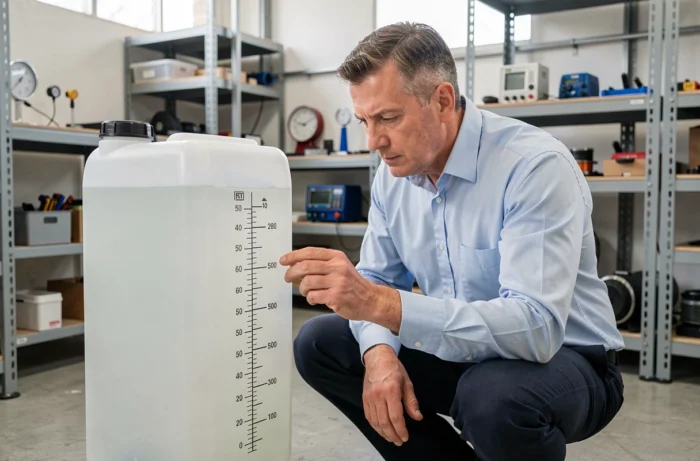
You have an area in square meters and you want to know how many liters that represents. The problem is that a square meter measures an area, not a volume. The conversion from m² to liters requires a third dimension: a thickness, a height, or a depth. Without this data, the calculation is impossible. Here is the complete method and concrete cases where this transition from area to volume becomes a useful reflex.
Why converting m² to liters requires a thickness
A square meter (m²) describes a flat surface. A liter describes a volume, which is a three-dimensional space. To convert from one to the other, you need to multiply the area by a height.
Let’s take a simple example. You have a rectangular container with a bottom area of 1 m². If this container has a depth of 10 cm, its volume is 1 m² x 0.10 m = 0.1 m³. Now, 1 cubic meter is exactly equal to 1,000 liters. So, 0.1 m³ = 100 liters.
The formula can be summarized in one line: area (m²) x height (m) x 1,000 = volume in liters. The challenge lies in correctly converting the height into meters before multiplying. A thickness of 5 mm is 0.005 m. A height of 30 cm is 0.30 m.
To delve deeper into the method, the conversion of 1 m² to liters is always based on this same principle: associating an area with a thickness to obtain a usable volume.
Quick conversion table: area, thickness, and liters

Rather than recalculating each time, a reference table allows you to find the result in a few seconds. Here are the most common combinations for an area of 1 m².
| Thickness | Thickness in meters | Volume obtained |
|---|---|---|
| 1 mm | 0.001 m | 1 liter |
| 5 mm | 0.005 m | 5 liters |
| 1 cm | 0.01 m | 10 liters |
| 5 cm | 0.05 m | 50 liters |
| 10 cm | 0.10 m | 100 liters |
| 50 cm | 0.50 m | 500 liters |
| 1 m | 1.00 m | 1,000 liters |
The table reveals a very practical reference: 1 mm of thickness over 1 m² gives exactly 1 liter. This ratio serves as the basis for all quick calculations.
For an area different from 1 m², simply multiply the result by the actual area. Example: 12 m² with 5 cm of thickness = 12 x 50 = 600 liters.
Rainwater on a roof: the most common concrete case
You may be looking to find out how many liters of water fall on your roof during a storm. This is the most common use case for converting m² to liters, and it follows the same rule.
1 mm of rain falling on 1 m² of roof corresponds to 1 liter of water collected before losses. This rule is used by professionals to size rainwater harvesting tanks. It is incorporated into standardized methods such as DIN 1989-1 for calculating installations.
Specifically, for a roof of 90 m², a rainfall episode of 12 mm represents 90 x 12 = 1,080 liters of gross potential. Losses related to evaporation and the runoff coefficient of the roofing material reduce this figure, but the initial calculation remains the same.
You can apply this logic to:
- Choosing the size of a recovery tank suitable for your roof area and local rainfall
- Estimating the amount of water needed to water a garden plot based on the desired water height per m²
- Calculating the volume of product (paint, resin, coating) to buy when the manufacturer indicates a yield in liters per m² for a given thickness
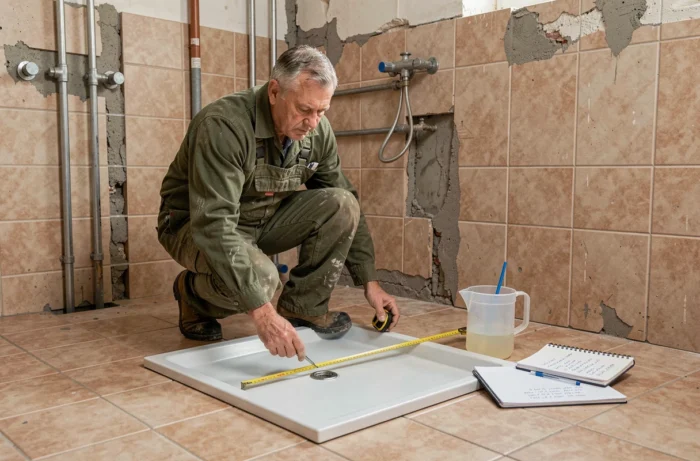
Paint, resin, and coating: converting m² to liters in daily life
On a paint can, the manufacturer often indicates a yield like “1 liter covers X m²”. This yield corresponds to a specific layer thickness. Finding the volume needed for a given area involves exactly the same calculation.
Imagine a coating to be applied at a thickness of 2 mm. To cover 15 m², the calculation gives: 15 x 0.002 x 1,000 = 30 liters. The manufacturer’s yield already incorporates the recommended thickness, but checking it yourself helps avoid unpleasant surprises (porous surface, double layer needed).
The same logic applies to floor resin, leveling compound, or self-leveling concrete. Each time a product is applied in a layer over a surface, you return to the formula: m² x thickness (m) x 1,000.
Common mistakes in calculating volume from an area
Two pitfalls frequently arise in this type of conversion.
The first: forgetting to convert the thickness to meters. If you multiply 1 m² by 5 (for 5 cm) instead of 0.05, the result is incorrect by a factor of 100. Always convert each measurement to meters before multiplying.
The second: confusing m² and m³. A square meter does not have a volume. Writing “1 m² = X liters” without specifying a thickness makes no physical sense. If someone asks you how many liters 1 m² is, the only correct answer is: it depends on the thickness.
To verify a result, the most reliable method remains the conversion table with the volume units column. Place the decimal point in the correct position starting from the m³: each sub-unit (dm³, cm³, mm³) shifts the decimal point three places. One cubic decimeter (dm³) is exactly 1 liter.
The conversion from m² to liters is ultimately just a multiplication, provided you never forget the third dimension. Keep the reference 1 mm on 1 m² = 1 liter: it covers most practical situations, from sizing a tank to calculating the volume of product to order.