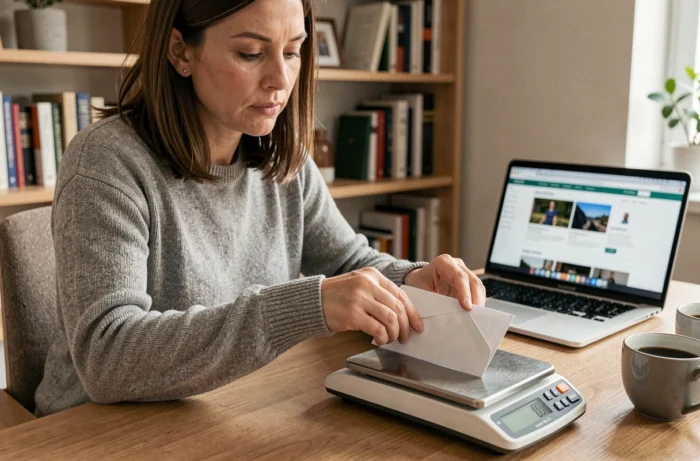
The postage rate for a letter depends on two factors: its weight and its format. Free online tools calculate the number of stamps or the amount to pay based on a weight you enter yourself. The reliability of the result therefore depends entirely on how accurate that figure is, raising an issue these calculators rarely address.
Envelope weight and dimensions: what an online calculator doesn’t check
A postage calculator assumes you know the total weight of your mail item, including the envelope. In practice, most users estimate the weight by counting the number of A4 sheets inside the envelope, without weighing the whole item.
The problem arises when the actual weight is close to a postage threshold. A difference of just a few grams can push the item into the next price band. A kraft envelope, a paper clip or a sticky note attached to the first page all add weight that an estimate based on the number of sheets won’t capture.
Format is another blind spot. A letter that is too thick or too large falls outside the standard rate, even if it is lightweight. La Poste’s price tables set size and thickness limits for each weight band. A tool that asks only for the weight ignores this restriction and may show a rate that is too low.
If you use an online letter scale to find out how much postage you need, check whether the tool also factors the envelope format into its calculation, or manually check the dimensions as well.

Green Letter, Tracked Letter and Services Plus rates: weight thresholds to know
La Poste uses the same weight bands for its three main services, but the prices vary considerably from one option to another.
Green Letter (2026 rates)
| Weight | Rate |
|---|---|
| Up to 20 g | 1,52 € |
| Up to 100 g | 3,10 € |
| Up to 250 g | 5,24 € |
| Up to 500 g | 7,41 € |
| Up to 1 kg | 9,29 € |
| Up to 2 kg | 11,14 € |
Tracked Green Letter (2026 rates)
| Weight | Rate |
|---|---|
| Up to 20 g | 2,02 € |
| Up to 100 g | 3,60 € |
| Up to 250 g | 5,74 € |
| Up to 500 g | 7,91 € |
| Up to 1 kg | 9,79 € |
| Up to 2 kg | 11,64 € |
Services Plus Letter (2026 rates)
| Weight | Rate |
|---|---|
| Up to 20 g | 3,47 € |
| Up to 100 g | 4,57 € |
| Up to 250 g | 5,78 € |
| Up to 500 g | 8,10 € |
| Up to 1 kg | 10,35 € |
| Up to 2 kg | 12,01 € |
The 20 g threshold is the most critical for everyday mail. Above that, the Green Letter price nearly doubles. Three standard A4 sheets with their envelope often exceed this threshold, meaning you have to move up to the next band.
How reliable are free calculators? Check the update date and rate source
Several websites offer free postage calculators. They all work in much the same way: select the type of mail (Green Letter, Tracked Letter or Services Plus), enter the weight, and the tool displays the corresponding price.
The main risk is outdated rates. La Poste adjusts its prices every year, sometimes partway through the year. A calculator that doesn’t show when it was last updated may use an outdated price table. Before relying on the result, look for a note on the page such as “2026 rates” or a date showing when it was last updated.
Another point to watch: some tools cover only mainland France. Mail sent to the French overseas departments and territories or abroad is subject to different price tables. A rate shown without specifying the destination is probably for mainland France only.
- Check that the tool specifies the current year’s rates and the date it was last updated.
- Make sure the calculation takes format (thickness and dimensions) into account, not just weight.
- If your item is being sent outside mainland France, use the calculator on La Poste’s website, which covers all destinations.
Weighing a letter without scales: alternative methods and their limitations
Without kitchen scales, the most common method is to estimate the weight based on the number of sheets. A standard-weight A4 sheet weighs a few grams. Multiply that by the number of pages and add the weight of the envelope to get an approximate figure.
This estimate works reasonably well for a simple letter with one or two sheets, as long as it is nowhere near a postage threshold. It becomes risky as soon as the total weight approaches the limit for a price band.
- Window envelopes and padded envelopes weigh considerably more than a standard thin envelope.
- A double-sided document printed on heavy paper can weigh twice as much as one printed on regular paper.
- Any additional item (business card, photo, USB drive) throws off an estimate based on the number of pages.
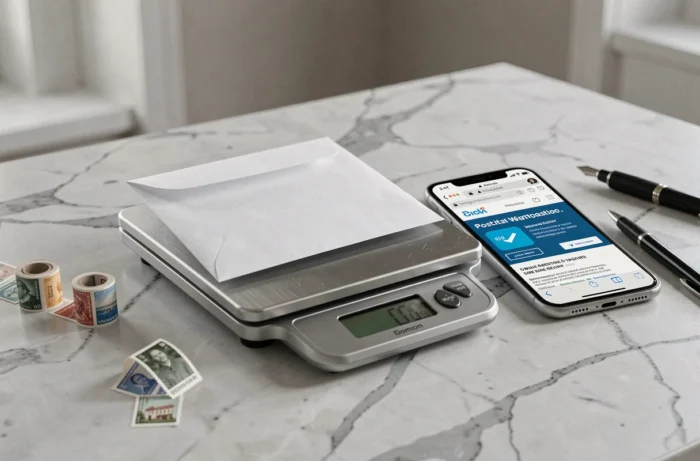
If in doubt, weighing the sealed envelope on a scale is the only reliable method. Digital kitchen scales, accurate to the nearest gram, are perfectly suitable. If you don’t have one, you can take your letter to a post office to have it weighed and stamped on the spot, avoiding any risk of error.
Stamps with permanent validity and annual price increases
“Green Letter” stamps sold in booklets bear the words “Green Letter” but have no face value in euros. They remain valid even after a price increase, provided the item meets the relevant conditions (weight and format for the applicable band).
Buying stamps before an annual price increase therefore lets you pay the previous rate. This can lead to real savings if you send mail regularly. However, make sure they are stamps with permanent validity, not postage labels printed with a fixed amount, which do not offer the same flexibility.
Online weighing tools are useful for quickly identifying the right price band. But they all have the same limitation: they calculate based on the information you provide. An approximate weight produces an approximate result, and an unchecked format can make the displayed rate invalid. For mail where insufficient postage could have consequences (official correspondence or a contractual document), using physical scales and checking the dimensions is the safest approach.