A soil rich in flint, limestone, or construction debris is not treated the same way as a clay soil scattered with a few pebbles. Before choosing a tool or method to remove stones from the garden, the petrographic nature and grain size of the material present in the soil dictate the strategy.
Grain size and rooting depth: calibrate the sorting before acting
The first mistake is to attack the ground without prior diagnosis. A probe with a crowbar or metal stake at five to six points spread across the plot allows for assessing the stony density and the depth of the fertile layer. If the stones are concentrated within the first fifteen centimeters, a simple mechanical pass is sufficient. If the rocky layer goes deeper, partial excavation should be considered.
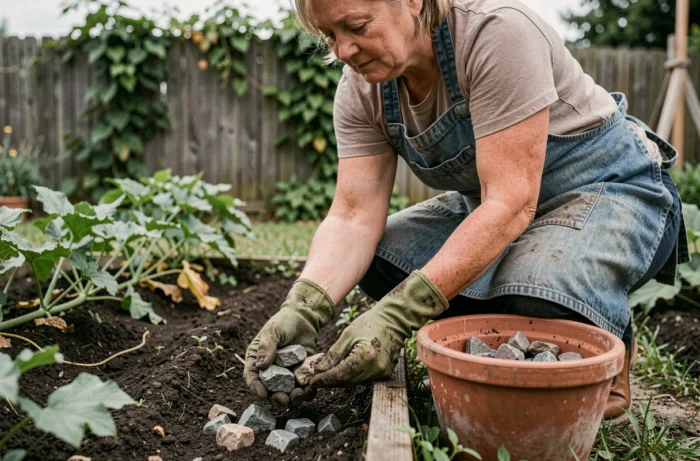
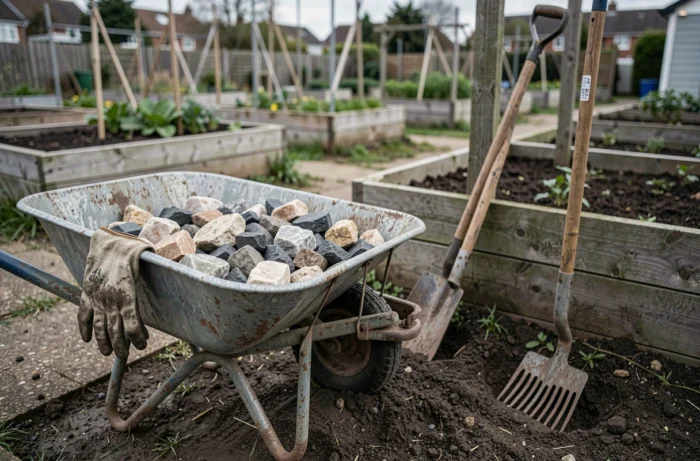
We recommend classifying the elements into three categories: fine gravel (less than one centimeter), medium stones, and large stones. Each category requires a different tool, and especially a distinct reuse approach. Fine gravel serves as drainage at the bottom of planters or planting holes, medium stones line pathways, and large stones can border flower beds.
This grain size sorting avoids throwing everything away at the dump and reduces the volume to be removed. If you are specifically looking for how to remove stones from a garden already landscaped with decorative gravel, the logic remains the same: separate the sizes to treat each fraction with the correct action.
Construction vacuum to remove gravel from flower beds
The use of a wet and dry vacuum cleaner type shop-vac to extract small stones from flower beds is gaining popularity. The principle: a wide hose (about 2.5 inches in diameter), rather short to limit clogs, sucks up surface gravel without uprooting plants.
The method requires working in small areas. You skim the soil without pushing the nozzle in, stop as soon as the suction weakens, and then sift the contents of the tank to separate reusable stones, soil, and organic debris. On a planted bed, this approach is more precise than a traditional rake that uproots young roots.
Manual sorting of large stones remains a prerequisite before using the vacuum. Elements larger than three centimeters risk clogging the tank or damaging the turbine. This technique is suitable for already landscaped plots, not for raw land to be cleared.
Rotavator and mechanical sieve: treating a stony ground deeply
For surfaces larger than a few dozen square meters, the rotavator attached to a tractor remains the reference for landscapers. The machine turns the soil and brings stones, roots, and debris to the surface. The pass must be done on dried soil, neither too dry (the blades bounce off the crust) nor too wet (the soil sticks and coats the stones).
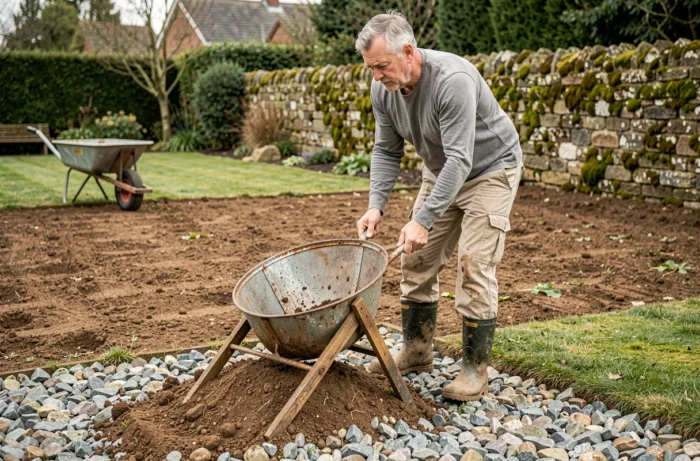
After the rotavator pass, a mechanical sieve sorts materials by size. Professionals use rotary sieves mounted on excavators or vibrating screens. For individuals, renting a tracked sieve is available by the day from equipment rental companies.
Recommended work sequence
- First pass of the rotavator at a shallow depth to break the crust and bring up surface elements, followed by manual collection of the larger blocks.
- Second deeper pass, perpendicular to the first, to reach the lower layer and homogenize the soil.
- Mechanical screening or sifting with a stone rake (tight-toothed model) to extract the last residues before leveling.
We observe that two crossed passes significantly reduce the number of stones that resurface after the first freeze-thaw season. A single pass leaves intact pockets of stones that migrate to the surface the following winter.
Capillary rise of stones: why stones return every year
Freeze-thaw cycles push stones to the surface year after year. Water that seeps under the stone freezes and expands, lifting the element by a fraction of a centimeter. Upon thawing, fine soil fills the void underneath. Season after season, the stone rises. This phenomenon, well-known in agronomy, explains why a “cleaned” plot in autumn presents new stones in spring.
Accepting this reality changes the strategy. Rather than aiming for a soil perfectly free of stones (an unattainable goal on naturally calcareous or siliceous ground), we recommend integrating light annual collection into the maintenance schedule, ideally at the end of winter when the soil is still loose.
Limit the rise with a buried geotextile
In areas designated for lawns or grass, laying a geotextile felt about fifteen centimeters deep slows down the migration of stones. The textile allows water and roots to pass through but blocks solid elements. This technique requires prior excavation and the addition of topsoil above, which represents a significant investment. It is justified on very stony grounds where annual collection would become too burdensome.
Value the extracted stones instead of disposing of everything
Disposing of cubic meters of stones at the dump is expensive and poses a logistical problem. Most garden stones find a second use on-site:
- Drainage layer at the bottom of planters, raised vegetable beds, and tree planting pits, replacing clay balls.
- Filling gabions to create retaining walls or decorative borders without concrete.
- Mineral mulch around Mediterranean plants (lavender, rosemary, santolina) that prefer well-drained and dry soil on the surface.
- Stabilizing underlayer for a pedestrian path, later covered with calibrated gravel or stepping stones.
Reusing stones on-site eliminates transportation costs and transforms waste into material. On a medium-sized plot, the volume of extracted stones is usually sufficient to cover drainage and landscaping needs without additional purchases.
Collecting stones in a garden is not a one-time project. It is a recurring maintenance task dictated by the geology of the land and freeze cycles. Adapting the method to the size of the stones, planning for their reuse, and integrating an annual pass into the gardening schedule remains the only realistic approach on naturally stony soil.