When coming across recent photos of Loni Willison taken in the streets of Los Angeles, the contrast with her fitness model shots from the 2000s is immediately striking. As of 2026, the situation for the former model remains unchanged: homeless, disconnected from support systems, visible in several neighborhoods of the city. Her journey raises concrete questions about the limits of support for people in extreme poverty in the United States.
Prolonged refusal of help: why Loni Willison remains on the streets in 2026
This is the point that most articles gloss over, even though it conditions everything else. For several years, Loni Willison has systematically refused offers of care: housing, detox centers, financial support. She has repeatedly expressed her desire to solve her problems on her own.
No reliable source reports a lasting stay in an institution or stable housing. This reflects a common situation among individuals facing both addiction and mental health issues: legal capacity is maintained, which prevents any hospitalization or placement without consent, even when physical deterioration is visible.
To better understand Loni Willison’s story in 2026, one must grasp this mechanism of refusal. It is not a lack of external solidarity; it is a blockage that comes from the individual herself, in a context where the American system cannot force an adult to accept help.
Loni Willison between Venice and Beverly Hills: a geography of precariousness in Los Angeles
In 2025 and 2026, Loni Willison has been spotted in quite different areas of Los Angeles. Witnesses and images place her in both the Venice area and residential neighborhoods near Beverly Hills. This geographical movement is not insignificant.
Venice has a significant homeless population, with relative access to food distributions and community organizations. Beverly Hills, on the other hand, presents an environment where people on the streets are more visible and frequently reported.
The fact that Loni Willison moves between these two environments suggests that she is not attached to a fixed encampment nor is she being followed by a local organization. She moves alone, without identifiable support, which further complicates the possibility of regular medical or social follow-up.
Divorce from Jeremy Jackson and domestic violence: the documented turning point
To understand Loni Willison’s trajectory, we always return to the same turning point. A fitness model in the 2000s, she married Jeremy Jackson in 2012. Jackson was then known for his role as Hobie Buchannon in Baywatch.
The divorce occurred in 2014. Loni Willison revealed that she was a victim of domestic violence during the marriage. The following years marked a rapid decline:
- Development of a severe addiction, with worsening consumption after the separation
- Emergence of mental health issues, with no specific public diagnosis but visible in her behavior as described by the media
- Progressive loss of her job, housing, and vehicle, leading to life on the streets
This sequence, documented by several consistent sources, spans less than two years after the divorce. The speed of the decline remains one of the most striking aspects of this story.
The absence of a safety net in the United States
One might wonder how a person with a media career ends up with no recourse. In the United States, in the absence of health insurance and stable income, access to psychiatric care and detox programs largely depends on the individual’s consent and their ability to navigate an administrative process.
Loni Willison does not have any known public family support. Jeremy Jackson, himself facing legal issues after their separation, has not been able to intervene. No close friend has managed to establish a lasting connection with her for several years.
Media and stolen images: what Loni Willison’s homeless photos raise
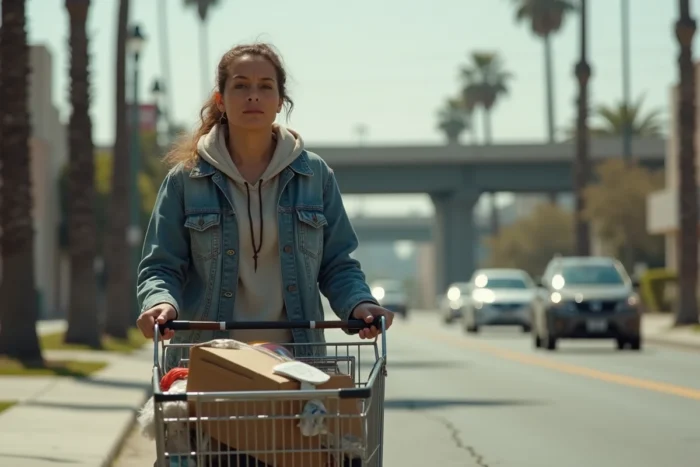
Each new series of photos reignites the same media cycle. A paparazzo or passerby publishes images of Loni Willison rummaging through trash or pushing a shopping cart, the media relay with headlines about her transformation, and then the subject fades away. In 2026, this pattern repeats itself.
The question that these publications rarely raise: Loni Willison has never given her consent for these broadcasts. She does not speak to the media, has no known representative, and has no control over the use of her image. We find ourselves in a gray area between legitimate information on a societal issue and the exploitation of a vulnerable person.
Online reactions oscillate between compassion and voyeurism. Some internet users start crowdfunding campaigns or calls for help, without these initiatives leading to any concrete change. Feedback varies on this point, but the observation remains the same: media coverage has produced no measurable effect on Loni Willison’s situation.
Loni Willison in 2026: a journey that raises questions beyond a mere news item
The case of Loni Willison encompasses several issues that go beyond her alone. The interplay between addiction, mental health issues, and homelessness affects tens of thousands of people in Los Angeles. The difference here lies in the contrast between past visibility and current situation.
What distinguishes her journey is the duration. Several years on the streets without interruption, without any stay in a facility, without a return to stable housing. This is not a one-time episode but an established situation, making any prospect of exit much more complex.
Loni Willison’s journey reminds us that extreme poverty cannot be resolved by mere external goodwill. As long as the individual refuses the help offered, and the legal framework protects that refusal, no system can force a change in trajectory.