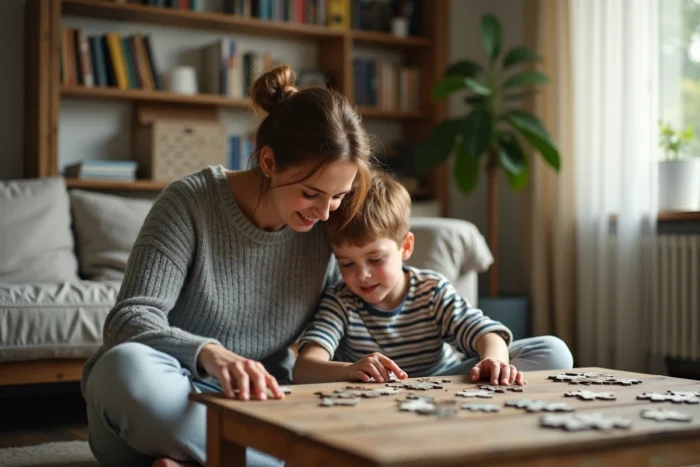
The psychological impact of growing up with a single mother is not limited to the absence of a second parent. Recent work in developmental psychology shifts the focus: family structure matters less than the quality of the emotional environment. However, we observe that this distinction remains poorly integrated into most mainstream content on single parenthood.
Secure attachment in single-parent families: the central predictive factor
Attachment theory provides the most operational framework for assessing the psychological impacts on children raised by a single mother. A secure attachment bond with a single stable caregiver produces developmental outcomes comparable to those observed in biparental configurations.
Research by Susan Golombok (study synthesized by Brewaeys et al.) shows that children of choice single mothers exhibit emotional and social well-being similar to that of children from biparental families, provided that emotional security and relational quality are maintained. The discriminating parameter is not the number of parental figures, but the consistency and predictability of the bond.
In practice, this means that a child whose mother provides reliable presence, appropriate emotional responses, and a stable educational framework does not present a higher psychopathological risk related to single parenthood as such. To delve deeper into the causes and consequences of single mothers on Claravox, this distinction between family structure and the quality of the bond is well documented.

Socioeconomic context and parental stress: the real risk factors
The conflation of single parenthood and children’s psychological difficulties masks a major methodological bias. Studies reporting emotional disorders or academic difficulties in children of single mothers do not always control for confounding variables: financial precariousness, social isolation, residual parental conflict post-separation.
Psychologist Raquel Córdoba (2024) states unequivocally: it is not the absence of a father that predicts difficulties, but the context of insecurity in which the child develops. A single-parent home without conflict, with sufficient resources and a support network, does not generate more chronic stress in the child than a dysfunctional biparental home.
We identify three genuinely predictive stress factors in children from single-parent families:
- Residential instability and repeated changes in school environment, which disrupt social markers and weaken peer relationships
- Persistent interparental conflict after separation or divorce, which keeps the child in a state of emotional hyper-vigilance independent of family structure
- Maternal exhaustion related to the overload of responsibilities, which reduces emotional availability and alters the quality of daily interactions
These factors are modifiable. They are not inherent to single parenthood.
Resilience and specific skills developed by children of single mothers
The literature on resilience (works synthesized by Ann Masten, analyses from Purdue University) identifies specific psychological resources in children raised by a single parent. These skills are not a compensatory byproduct but developmental acquisitions in their own right.
Early autonomy in problem-solving: the child participates more in daily decisions and develops a superior adaptability to unforeseen circumstances. This autonomy, when framed by a clear educational structure, is an asset in school and social contexts.
Flexibility in the face of changes is another marker. Children from single-parent families learn earlier to navigate between different environments (home, school, extended family), which enhances their situational adjustment capacity.
There is also a more pronounced relational empathy. The child who perceives their single parent’s efforts develops an increased sensitivity to others’ constraints and an ability to value non-material resources. This empathy does not stem from pathological parentification, but from accelerated emotional maturation in a secure setting.
Parentification and limits of early autonomy
The risk arises when the child finds themselves in a position of emotional support for the parent. The boundary between healthy autonomy and parentification depends on the mother’s ability to maintain a clear relational asymmetry. The child can help, participate, and understand, but must not become the confidant or emotional regulator of the adult.
We recommend particular vigilance regarding two signals: the child who systematically censors their own needs to avoid “adding stress” to the parent, and the child who adopts a mediator role with the extended family or the other parent.
Single mother by choice or after separation: distinct psychological trajectories
The paths are not interchangeable. A single mother by choice (using assisted reproductive technology, an assumed parental project) places the child in a coherent family narrative from the outset. The absence of the second parent is integrated into the narrative framework, which significantly reduces the risk of loyalty conflict or feelings of abandonment.
After a divorce or a contentious separation, the situation differs. The child must reconstruct their family story, manage emotions related to the loss (even symbolic) of a parent, and sometimes navigate between two contradictory educational systems. The main adaptation factor remains the mother’s ability not to instrumentalize the child in the conflict with the other parent.
The difference between these two trajectories is documented but rarely considered in articles on single parenthood. A child of a choice single mother and a child whose parents are embroiled in a divorce do not share the same risks or needs for support.
School adaptation and social life of the child
Academic difficulties attributed to single parenthood are largely correlated with parental stress and instability, not with family structure. A child whose single mother maintains regular educational follow-up, open communication with the school, and a predictable lifestyle does not exhibit specific school dropout.
The child’s social life depends more on the quality of the network around the family (grandparents, close friends, neighborhood) than on the presence of two parents in the home. An active support network largely compensates for the absence of a second parent in terms of social development.
Single parenthood is not a diagnosis. It is a living environment whose effects on the child vary according to specific and modifiable parameters. Focusing attention on the quality of the bond, the stability of the context, and the support network rather than on family structure remains the most solidly supported recommendation by current research.