Portulaca is harvested abundantly in summer, but once the first cold weather sets in, the plant disappears from the vegetable garden. Preserving its leaves or extending its cultivation during the cold season involves choosing between several methods, the effectiveness of which varies depending on the available space, the type of portulaca grown, and the expected culinary result. This article compares the main options for preserving portulaca in winter at home, based on the characteristics of each technique.
Summer portulaca and winter portulaca: two plants, two conservation strategies
Before comparing the methods, a crucial distinction must be made. Common portulaca (Portulaca oleracea) is an annual summer plant whose fleshy leaves do not withstand frost. Winter portulaca, or Claytonia perfoliata, is a different species that tolerates temperatures close to 0 °C and remains productive in winter in a sheltered space.
The preservation of portulaca in winter can therefore aim for two distinct objectives: to store the leaves of summer portulaca harvested at the end of the season, or to maintain a living production of Claytonia throughout the winter.
| Criteria | Common portulaca (summer) | Claytonia (winter) |
|---|---|---|
| Natural harvest period | June to September | October to March |
| Cold resistance | None (freezes at the first frosts) | Good as long as the temperature stays above 0 °C |
| Possible preservation | Refrigerator, freezing, vinegar | Continuous cultivation in a pot or sheltered container |
| Flavor after preservation | Texture altered by freezing, flavor preserved in vinegar | Fresh leaves, intact flavor |
| Effort required | One-time preparation | Light but regular maintenance |
This table summarizes the main trade-off. If fresh flavor and crunchy texture matter, growing Claytonia in winter yields a superior result to storing frozen leaves.
Freezing, vinegar, or refrigerator: which method best preserves portulaca leaves
For common portulaca harvested at the end of summer, three techniques are commonly mentioned in preservation guides. Their results differ in terms of storage duration, taste, and possible culinary uses.
Refrigerator: a few days, no more
Washed and dried portulaca leaves, placed in a damp cloth in the refrigerator, last a few days. The plant wilts quickly as its fleshy stems lose moisture. This method is suitable only for immediate use in salads.
Freezing: long duration, sacrificed texture
Freezing portulaca allows it to be kept for several months. Briefly blanched leaves placed in a sealed bag in the freezer retain some of their slightly tangy flavor. However, the crunchy texture completely disappears after thawing. Frozen portulaca is therefore intended for soups, stir-fries, or fillings, not salads.
Preservation in vinegar: modified flavor but long-lasting
Marinating the stems and leaves in white or cider vinegar with spices (garlic, mustard seeds, pepper) produces a tangy condiment that can be stored for several months in a sterilized jar. The original flavor of portulaca blends with that of the vinegar, which is pleasing as an accompaniment but does not replace fresh leaves.
- For a winter salad with the original texture, none of these three methods is perfectly suitable: the refrigerator is too short, freezing alters the texture, and vinegar changes the taste.
- For cooking in soup or hot garnish, freezing remains the most practical and flavor-neutral solution.
- For an original condiment to serve with charcuterie or cheese, preservation in vinegar yields an interesting result that few competitors mention.
Indoor cultivation of winter portulaca: containers, light, and micro-production
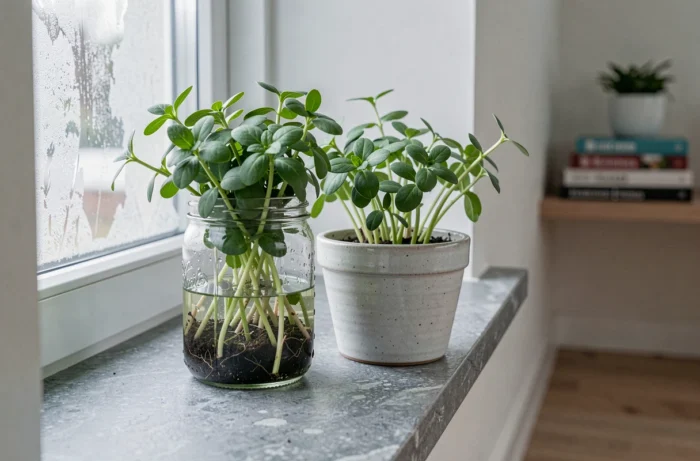
Rather than storing leaves, a more effective approach is to grow Claytonia in containers indoors throughout the winter. This plant grows in ordinary soil, requires little water, and tolerates cool environments.
Glazed balcony or unheated loggia: the domestic cold greenhouse
Recent guides on growing Claytonia perfoliata recommend container cultivation on glazed balconies or unheated loggias. These spaces act as a domestic cold greenhouse: Claytonia remains productive all winter as long as the temperature does not drop below 0 °C. A winter cover added during severe frosts is enough to protect the plants.
The substrate should remain slightly moist without excess. Moderate watering once or twice a week is suitable in most cases. Claytonia requires neither fertilizer nor rich soil, which simplifies cultivation for beginners.
Horticultural LED for poorly exposed windows
In a north-facing apartment or one with little natural light in winter, the growth of Claytonia slows considerably. Recent guides for indoor edible plants indicate that placing the plants 30 to 60 cm away from a horticultural LED lamp allows for slow but continuous growth even without direct sunlight.
This micro-production will not replace a summer vegetable garden, but it regularly provides a few handfuls of fresh leaves to enhance a salad or soup. The electrical cost of a small horticultural LED remains low, and the plant takes up no more space than a pot of herbs on a countertop.
Soil, sowing, and calendar: successfully planting Claytonia before winter
To have fresh leaves by November, sowing Claytonia should be done in late summer or early fall. The seeds are sown on the surface in a container filled with ordinary potting soil, barely covered with soil. Germination occurs in one to two weeks if the soil remains moist.
- Sow in August or September for a first harvest in October-November.
- Use shallow containers (about fifteen centimeters are sufficient) as Claytonia has a shallow root system.
- Thin the plants to leave a few centimeters between each one, which promotes larger leaves.
- Harvest by cutting the outer leaves and leaving the heart intact so that the plant continues to produce.
This method of continuous harvesting allows for extending production over several months without reseeding. A single medium-sized container provides enough leaves for two to three salads per week.
Claytonia is also distinguished by its sweet and slightly sugary flavor, different from common portulaca, which leans more towards tangy. In cooking, it can be used raw in salads, as a sandwich garnish, or lightly sautéed with shallots and a drizzle of cream. For those who enjoy the texture of summer portulaca, winter Claytonia offers the closest alternative in terms of crunchiness and freshness.
The choice between preserving summer portulaca leaves and growing Claytonia in winter depends on the space available and the desired culinary result. Storage methods (freezing, vinegar) meet an occasional need. Cultivating in containers on a glazed balcony or under LED provides a regular supply of fresh leaves without disproportionate effort.