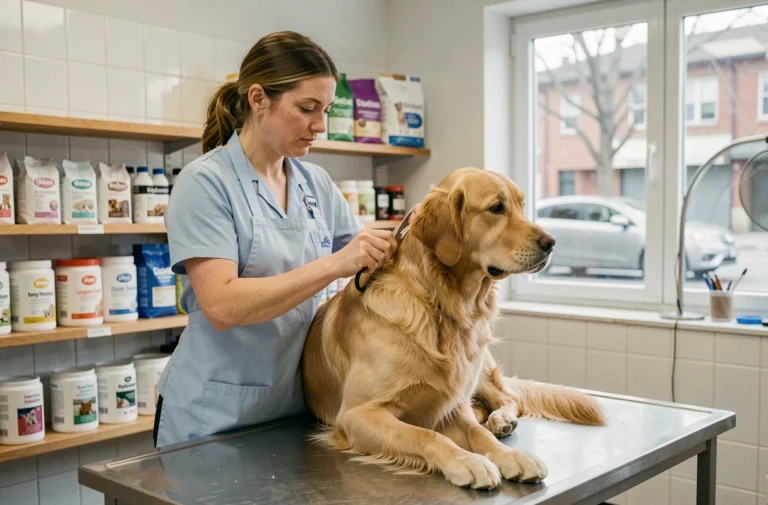
The attachment to a pet does not produce the health benefits that the mainstream media has attributed to it for years. A study published on July 29, 2026, in PLOS One by Marti R. and colleagues challenges the media consensus: pet owners were not healthier than non-owners and even reported a slightly worse state of health. This finding requires a reevaluation of recent animal news through a more rigorous lens.
Animal socio-emotional support and loneliness: a documented paradoxical link
People who report receiving a lot of socio-emotional support from their animal also report greater loneliness and lower psychological well-being. This result, from the same Swiss study (Marti R. et al., PLOS One, July 2026), invalidates the simplistic narrative of the animal-as-remedy.
The quality of the relationship matters more than the intensity of the attachment. A very attached owner to their dog but socially isolated does not gain the same benefit as a person integrated into a human network who also has a pet. The authors emphasize that the overall relational context determines the actual effect of cohabitation.
We observe that this nuance is absent from almost all Francophone animal news feeds, where every rescue or adoption is presented as a default happy ending story. Browsing the news on Univers Animaux allows you to find these narratives, but their reading benefits from being informed by this recent data.
Animals and vulnerable people: what the Frontiers in Psychology study of July 2026 shows
A publication released in July 2026 in Frontiers in Psychology examined a segment of the population rarely covered by mainstream media: the homeless, victims of domestic violence, economically precarious individuals. In the vast majority of cases studied, the animal is the only source of physical contact and emotional support.
The striking figure is clear: in 90% of the cases studied, dogs and cats represented the only stable companionship. This is not a touching anecdote; it is an indicator of the failure of the social fabric surrounding these individuals.
Why this result changes the reading of animal-related news
When a media outlet reports that a homeless person refuses emergency shelter because their dog is not allowed, the usual interpretation oscillates between sentimentality and misunderstanding. The Frontiers study provides a framework: for this person, losing access to their animal equates to losing their only functional emotional connection.
Public housing policies that prohibit animals therefore produce an effect contrary to their objective. Several experimental initiatives in Europe are beginning to integrate this data, but no national regulatory framework mandates the acceptance of animals in emergency structures in France to date.
Attachment theory applied to animals: an expanding field of research
Attachment psychology, originally developed to describe parent-child bonds, is increasingly being used to analyze the human-animal relationship. Recent studies show that attachment styles to animals replicate the patterns observed between humans: secure, anxious, or avoidant attachment.
An owner with an anxious attachment profile will tend to over-invest in the relationship with their animal, which may explain the paradox highlighted by the Swiss study. The animal then becomes a tense relational substitute, not a balancing complement.
- Secure attachment: the owner enjoys the animal’s company without depending on it for emotional regulation and maintains an active human social network.
- Anxious attachment: the animal occupies a central place in stress management, with an increased risk of perceived loneliness when the animal is absent or ill.
- Avoidant attachment: the relationship remains functional (feeding, walking) without marked emotional investment, which limits both benefits and psychological risks.
We recommend keeping this framework in mind when reading viral adoption or rescue stories. The emotional narrative often masks a more complex relational dynamic.
Unusual animal news: separating the viral from the verifiable
Animal news feeds operate on a specific editorial model: a photo or video with a strong emotional charge, a short text, a call to share. The format favors rescue stories, anthropomorphized animal behaviors, and absurd records.
The problem is not entertainment; it is the lack of context. A kitten found in a trash can and adopted by a loving family makes a beautiful story. But without data on the survival rate of stray kittens, local sterilization conditions, or shelter saturation, the anecdote provides no understanding of the phenomenon.
Criteria for evaluating animal news
- Does the source cite a study, a veterinarian, or an identifiable organization, or does it limit itself to the owner’s testimony?
- Is the story reproducible (a protocol, a method) or purely anecdotal (a unique event without transferable lessons)?
- Does the media distinguish between correlation and causation when attributing a health benefit to the presence of an animal?
- Are the mentioned wild species covered by a protection status, and does the article specify this?
These filters do not eliminate the pleasure of reading a touching story. They allow for identifying those that provide exploitable information beyond immediate emotion.
The coming months will produce their share of viral videos and spectacular rescues. The 2026 data on the human-animal bond invites us to read these narratives with a dual perspective: appreciate the story, then verify what it truly says about animal welfare and our relationship with it.